Good training begins by understanding the dog in front of you.
There is no single training method that works identically for every dog.
Breed tendencies, temperament, motivation, age, previous experiences and the individual dog’s personality all influence how they learn.
Our Labradors and Clumber Spaniels are raised with the same fundamental expectations — but we don’t expect them to learn in exactly the same way.
The Basics Every Puppy Should Learn
Regardless of breed, we believe every puppy benefits from strong foundations.
These include:
Name recognition — learning that paying attention to their person is worthwhile.
Recall — coming when called should be one of the most rewarding behaviours a puppy knows.
Loose-lead foundations — learning to move with a person rather than simply being restrained by a lead.
Sit, down and stay/wait — useful communication rather than tricks performed simply for the sake of obedience.
Settle — one of the most underrated skills we can teach.
Dogs need to learn that doing absolutely nothing is sometimes the correct answer.
Handling and grooming — paws, ears, mouth, brushing and general body handling should become normal.
Polite greetings — four feet on the floor is considerably nicer once your puppy weighs 30kg.
Leave it/drop — particularly useful when living with a Labrador whose definition of “food” can be surprisingly broad.
Crate and confinement skills — not as punishment, but as the ability to comfortably relax in a safe space.
Confidence and environmental exposure — different surfaces, sounds, places, people and everyday experiences introduced appropriately rather than overwhelming the puppy.
Training a Labrador
Harness the enthusiasm.
Labradors often learn quickly because many of the things humans can offer — food, toys, retrieving, praise and interaction — are already valuable to them.
The challenge isn’t always convincing a Labrador to participate.
Sometimes it’s teaching them that enthusiasm and self-control can coexist.
Short, successful sessions
Keep early sessions brief and rewarding.
Five excellent repetitions are more valuable than twenty increasingly sloppy ones.
Use their food motivation
A portion of daily food can become training rewards rather than automatically appearing in a bowl.
This gives ordinary behaviours value without continually adding unnecessary calories.
Teach calmness deliberately
This is particularly important.
Exercise alone does not teach a dog how to settle.
Constantly attempting to “wear out” an energetic Labrador can instead create an extremely fit Labrador who expects hours of entertainment.
Reward calm behaviour.
Teach place or mat work.
Allow downtime.
Make relaxation part of training.
Don’t forget impulse control
Waiting at doors, remaining calm around food, polite greetings and learning that they cannot immediately have everything they want are important life skills.
Retrieving is useful
For many Labradors, retrieving can be used as both enrichment and reward.
It can also strengthen engagement between dog and handler when used thoughtfully.
Training a Clumber Spaniel
Cooperation beats repetition.
Trying to train a Clumber exactly like a Labrador can leave both parties wondering what went wrong.
Clumbers can be extremely capable learners, but motivation matters enormously.
Give the behaviour a reason
Endless repetition can quickly lose its appeal.
Keep training varied, worthwhile and relatively short.
Don’t confuse thoughtfulness with stupidity
If a Clumber stops responding, repeating the command louder rarely improves matters.
Ask instead:
Does the dog understand?
Is the reward worthwhile?
Have I repeated this too many times?
Is something in the environment more valuable?
Find their currency
Food may work.
Toys may work.
Sniffing may work.
Access to something interesting may work.
The reward is whatever the dog actually values, not what we think they ought to value.
Keep your sense of humour
A battle of wills with a Clumber is rarely productive.
Clear expectations, consistency, reinforcement and a little creativity will take you considerably further.
Assistance & Working Foundations
Some puppies demonstrate characteristics that may make them potential candidates for assistance, therapy or other working roles.
For those puppies, foundations can include:
- Engagement with the handler
- Environmental confidence
- Appropriate recovery after something unexpected
- Settling around distractions
- Body handling
- Impulse control
- Recall
- Loose-lead foundations
- Comfortable confinement
- Learning how to learn
We cannot guarantee that a young puppy will ultimately qualify for assistance work.
Development, health, temperament, future experiences, training and the specific tasks required all influence eventual suitability.
What we can do is give promising puppies the strongest foundation we reasonably can.
Every dog is an individual.
Breed gives us useful clues about motivation and behaviour, but good training means observing the dog in front of us and adapting accordingly.
Your First Week With a Labrador Puppy
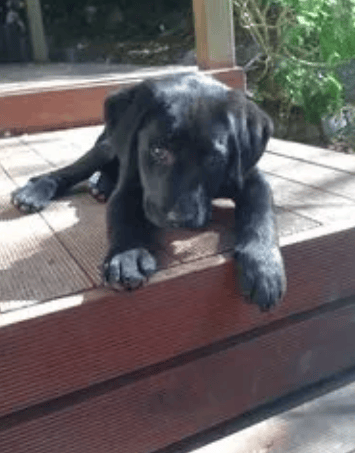
The first week isn’t about obedience. It’s about building the foundations for everything that comes next.
Bringing home a Labrador puppy is exciting.
It’s also exhausting, messy and occasionally leaves you wondering how something so small managed to steal a shoe, tip over a water bowl and fall asleep in the middle of the destruction within five minutes.
Your puppy has just left everything familiar—their mother, littermates, breeder, smells, routines and environment.
The first week should therefore be about security, routine and relationship, not seeing how many commands you can teach.
Keep Their World Small
There’s no need to introduce your puppy to everyone you know during their first few days.
Let them learn their new home.
Show them where they sleep, where they toilet, where they eat and where they can feel safe.
Introduce new experiences gradually.
Socialisation does not mean exposing a puppy to as much as possible as quickly as possible.
Good socialisation means helping them experience the world without becoming overwhelmed by it.
Start the Routine Immediately
Puppies thrive when life becomes predictable.
From the first day, begin establishing a loose routine around:
- Meals
- Toilet breaks
- Sleep
- Play
- Short training sessions
- Quiet time
It doesn’t need to run like a military schedule.
It simply helps your puppy begin understanding what happens next.
Toilet Training
– While we start toilet training for you, puppies are still young and training will still need to be followed through.
Take your puppy outside:
- After waking
- After eating
- After drinking
- After playing
- Before bed
- Whenever you notice sniffing, circling or suddenly wandering away
Reward success.
If an accident happens indoors, clean it and move on.
Punishing a puppy after an accident doesn’t teach them where they should toilet.
Sleep Is Training Too
Labrador puppies can become tiny land sharks when overtired.
Suddenly everything is exciting.
Hands.
Feet.
Furniture.
Children.
Your trousers.
Sometimes the answer isn’t more exercise.
It’s sleep.
Young puppies need a great deal of it.
Teaching a puppy to comfortably settle in a crate, pen or quiet sleeping area is therefore one of the most useful things you can do.
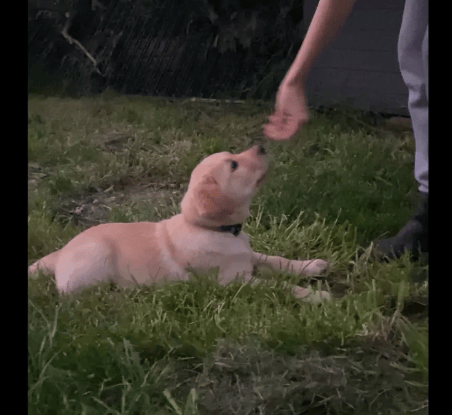
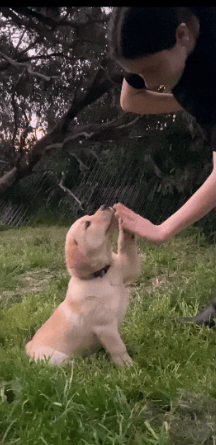
Begin With Attention, Not Commands
Before worrying about a perfect sit, teach your puppy that you matter.
Say their name.
When they look at you, reward them.
Move away.
Let them follow.
Reward voluntary check-ins.
Play together.
These tiny interactions create the foundation for recall, loose-lead walking and virtually everything you’ll teach later.
Introduce Recall as the Best Game in the World
Don’t wait until your puppy is six months old and running toward something interesting.
Start immediately.
Call them over short distances when success is almost guaranteed.
Reward generously.
Sometimes release them straight back to whatever they were enjoying.
You want:
“Come!”
to mean:
Something brilliant is about to happen.
Not:
Fun is over.
Don’t Accidentally Create an Athlete
Labradors often have enormous enthusiasm for activity.
That doesn’t mean a puppy needs to be exhausted every day.
Appropriate exercise is important, but so are sniffing, problem-solving, chewing, training and rest.
Your goal isn’t to see how tired you can make your Labrador.
It’s to raise a dog who knows how to be active and how to stop.
That brings us to one of our favourite skills…
Teaching an Off Switch
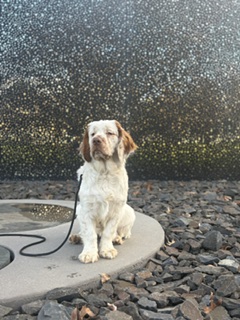
Your First Week With a Clumber Spaniel Puppy
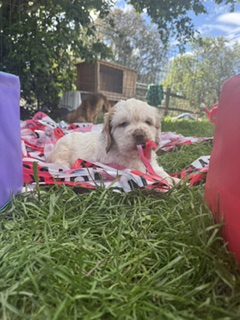
Life at a slightly different speed.
A Clumber Spaniel isn’t simply a slower Labrador with longer ears.
And they’re definitely not just a large version of another spaniel.
Clumbers are very much their own dog.
They can be affectionate, clever, gentle, funny, stubborn, thoughtful and occasionally spectacularly unimpressed with your plans.
That’s part of their charm.
Clumbers Think
Ask many Labradors to do something they’ve learned and you’ll often see immediate enthusiasm.
Ask a Clumber and you may see…
consideration.
This can sometimes be mistaken for stubbornness or lack of intelligence.
Clumbers are intelligent dogs.
But repetition for repetition’s sake can lose its value quickly.
Training tends to work much better when sessions are short, interesting and worthwhile.
They’re Close Without Necessarily Being Frantic
Many Clumbers develop deep relationships with their people.
They often enjoy simply being nearby.
They don’t necessarily need someone entertaining them every waking moment, but they generally want to know where their people are and be part of everyday life.
They’re Stronger Than They Look
A Clumber is a substantial dog.
That adorable lumbering puppy eventually becomes a powerful adult, so loose-lead walking and manners should begin while they’re small.
Waiting until they’re capable of towing you down the road makes the lesson considerably more interesting.
Yes, There Is Drool
Let’s address it.
Some Clumbers drool more than others.
There may be slobber.
There may be water carried halfway across the room after drinking.
And their white hair has an extraordinary ability to contrast perfectly with almost every dark piece of clothing you own.
If you’re looking for a pristine, maintenance-free dog, a Clumber may challenge your definition of pristine.
Grooming Is Part of Ownership
Regular attention should be given to:
- Ears
- Feet
- Feathering
- Coat
- Nails
- Skin
Starting grooming and handling during puppyhood makes life considerably easier.
Exercise Should Be Sensible
Clumbers aren’t ornaments.
They enjoy walks, sniffing, exploring and activities with their people.
But they’re also a heavy breed, and developing bodies should be treated accordingly.
Mental enrichment can tire a thoughtful dog remarkably well without requiring endless physical exercise.
Keep Them Lean
A Clumber should be substantial.
They shouldn’t be fat.
Maintaining an appropriate body condition is one of the simplest things an owner can do to support long-term mobility and health.
You Need a Sense of Humour
Perhaps most importantly:
Don’t enter a battle of wills with a Clumber.
You may technically win.
Neither of you will particularly enjoy it.
Learn what motivates your individual dog, make the right choice worthwhile and keep training interesting.
Living with a Clumber is not quite like living with anything else.
Those of us who love them wouldn’t have it any other way.
Teaching an Off Switch
One of the most valuable behaviours isn’t doing something. It’s doing nothing.
Many owners understandably believe:
Energetic dog = needs more exercise.
Sometimes that’s true.
But continually increasing exercise can create another problem:
a very fit dog who has never learned how to relax.
Calmness Is a Skill
We teach sit.
We teach down.
We teach recall.
We teach loose-lead walking.
Yet somehow we expect dogs to automatically understand:
“Nothing is happening now. Relax.”
Some do.
Others need help learning it.
Don’t Reward Constant Demands
A dog brings the ball.
You throw it.
They bring it again.
You throw it.
Again.
Again.
Again.
Eventually the dog learns:
If I demand activity, activity happens.
Instead, create clear beginnings and endings.
Play.
Train.
Walk.
Explore.
And then:
Finished.
The ability to transition between activity and rest is incredibly valuable.
Capture Calm
When your puppy chooses to lie quietly…
notice it.
Quietly reward them.
Drop a treat between their paws.
Don’t turn it into an exciting training session.
You’re simply reinforcing:
This behaviour pays too.
Introduce a Mat or Bed
A mat can become a portable cue for relaxation.
Start by rewarding your dog for:
- Approaching the mat.
- Standing on it.
- Sitting.
- Lying down.
- Remaining there calmly.
Gradually increase duration.
Eventually the mat can travel with you—to cafés, training, appointments, friends’ homes or anywhere else your dog may need to settle.
Boredom Isn’t an Emergency
Dogs don’t require entertainment every waking moment.
Appropriate opportunities to play, exercise, sniff, chew and learn are essential.
But so is learning that sometimes…
nothing happens.
That’s normal life.
An Off Switch Doesn’t Remove Drive
This is important.
Teaching a dog to settle doesn’t make them less capable of working.
A dog can be enthusiastic, motivated and energetic when asked while still being able to relax when the job is finished.
For us, that’s one of the most valuable qualities a Labrador can possess.
The goal isn’t a dog that never gets excited. It’s a dog who knows how to come back down again.
Preparing a Potential Assistance Prospect
Potential begins with temperament. Success depends on much more.
There Is No Guaranteed Assistance Puppy
An eight-week-old puppy can show wonderful qualities.
Confidence.
Engagement.
Resilience.
Trainability.
Human focus.
But nobody can responsibly guarantee exactly what that puppy will become as an adult.
Health, development, adolescence, experiences, training and the eventual tasks required all influence whether a dog remains suitable.
We therefore use the term:
Potential Assistance Prospect.
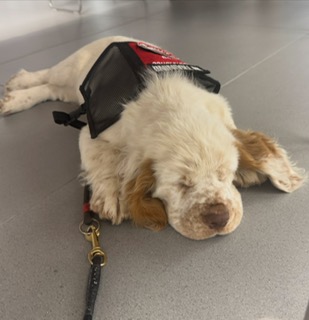
What Are We Looking For?
Depending on the future role, qualities we value may include:
Human engagement
Does the puppy naturally enjoy interacting and working with people?
Confidence
Can they explore unfamiliar situations without becoming overwhelmed?
Recovery
Being startled isn’t necessarily a problem. What matters enormously is what happens next.
Can the puppy recover and continue?
Trainability
Does the puppy enjoy learning and interacting for reinforcement?
Ability to settle
Working dogs spend surprisingly large amounts of time doing nothing.
Waiting rooms.
Appointments.
Public transport.
Restaurants.
Workplaces.
A dog that can only function while constantly occupied may find that lifestyle difficult.
Environmental stability
Different surfaces, noises, movement and environments should become normal parts of life.
Appropriate sociability
An assistance dog doesn’t necessarily need to greet every person and dog they encounter.
In fact, learning that other people and dogs can exist without requiring interaction is extremely valuable.
Early Training Foundations
Potential prospects can begin learning:
- Name response
- Handler engagement
- Recall
- Loose-lead foundations
- Settle
- Mat work
- Body handling
- Grooming tolerance
- Comfortable confinement
- Impulse control
- Appropriate greetings
- Confidence around everyday environments
- Ignoring ordinary distractions
These aren’t impressive assistance tasks.
They’re something more important:
foundations.
Complex work is much easier to teach when the dog already knows how to learn.
Socialisation Does Not Mean Meeting Everyone
This misconception deserves its own section.
A future assistance prospect doesn’t need fifty strangers patting them.
They need to learn that strangers are normal.
Dogs are normal.
Shopping trolleys are normal.
Children are normal.
Wheelchairs, walking aids, unusual noises, traffic and different surfaces can all become ordinary parts of the environment.
The objective isn’t:
“Go interact with everything.”
It’s:
“You can notice something without needing to respond to it.”
That’s an enormous distinction.
Protect the Puppy
More exposure isn’t automatically better exposure.
Flooding a young puppy with experiences they’re not ready to handle can undermine the confidence we’re trying to develop.
Quality matters more than quantity.
Let Them Be Puppies
A potential assistance prospect is still a puppy.
They need:
- Play
- Sleep
- Exploration
- Appropriate dog interactions
- Opportunities to make choices
- Time simply being a dog
Their entire childhood shouldn’t become a job interview.
Adolescence Changes Things
A promising eight-week-old puppy may behave very differently at eight months.
Adolescence can bring temporary fear periods, distraction, hormonal changes and shifts in confidence.
Assessment therefore isn’t something that happens once.
It’s ongoing.
And Sometimes the Right Decision Is to Stop
If a dog grows up and shows that assistance work isn’t right for them, that’s not failure.
The dog’s welfare matters too.
A wonderful family companion who wasn’t suited to assistance work is still a wonderful dog.
The Proudpaws Approach
Where one of our puppies shows promising qualities for future assistance work, we’re happy to discuss those needs with prospective families and consider them when matching puppies.
We do not add a premium to the puppy price simply because a puppy shows assistance potential.
The puppy still requires considerable ongoing development and training, and suitability can never be guaranteed.
What we can offer is something we believe every puppy deserves anyway:
a carefully considered beginning.

